
In November, I was invited by monster theorist Line Henriksen and poet Martin Cathcart Fröden to give a talk to students and teachers in creative writing at Malmö University – and had such a good time! I explained how I’m truly hooked on with everything translation as well as how it happened:
I first started translating for my research on Chinese and Sinophone fiction. This included translating short passages as directly as possible – with important terms preserved in square brackets within the quote.
Having studied and written about Sinophone fiction for a longish while, I felt that the Danish readers were missing out on a lot of good stuff – and I wanted to introduce them to literary experimentalists like Can Xue (not just Yu Hua), sensory modernists like Chen Ran (not just Mo Yan), and science fiction masters like Chi Hui, Tang Fei and Shuang Chimu (not just Liu Cixin).
Luckily, I wasn’t alone in my ambition, and I quickly found Korridor, a small press gradually falling for and specialising in delightful and daring non-mainstream fiction from East Asia. I had already contacted the wonderful author and scholar Chi Ta-wei who fortunately liked the idea of me translating his queer SF masterpiece 膜 (Membranes) into Danish.

And so I did. And it was such tremendous and challenging fun that I’m doing it again, this time with Dorothy Tse‘s mesmerising Hong Kong fable 鷹頭貓與音樂箱女孩 (Cat Eaglehead and the Music Box Ballerina). She is awesome. Read everything she writes.
I discovered that translation is a form of creative writing, not least between such fundamentally different languages as Chinese and Danish. Translation doesn’t just happen, it’s corporeal, it’s personal. As Don Mee Choi puts it: “I’m that tongue that has licked and groomed every word and punctuation.”
The funny thing is that, after engaging more intensively with translation, it has made its way full circle back into my research in a new way. I’m currently writing about literary plants where translation as metaphor and theoretical stance has come in extremely handy for understanding and analysing texts that attempt to write about, with, and from the perspective of such radically different beings as plants. See for ex. Companion Plant Reading: Translating Vegetal Voices.
I also talked about my love for East Asian speculative fiction and shared this short off-the-top-of my-head list of Dreamy Books (as Martin called it) in English translation + readings for queering translation:
Strange beasts of China, Yan Ge / Jeremy Tiang tr.
The way spring arrives, eds. Yu Chen and Regina Kanyu Wang
Cursed bunny, Bora Chung / Anton Hur tr.
The Membranes, Chi Ta-wei / Ari L. Heinrich tr.
The rainforest, Chi Hui /Jie Li tr.
Biogenesis, Tatsuaki Ishiguro / Brian Watson and James Balzer tr.
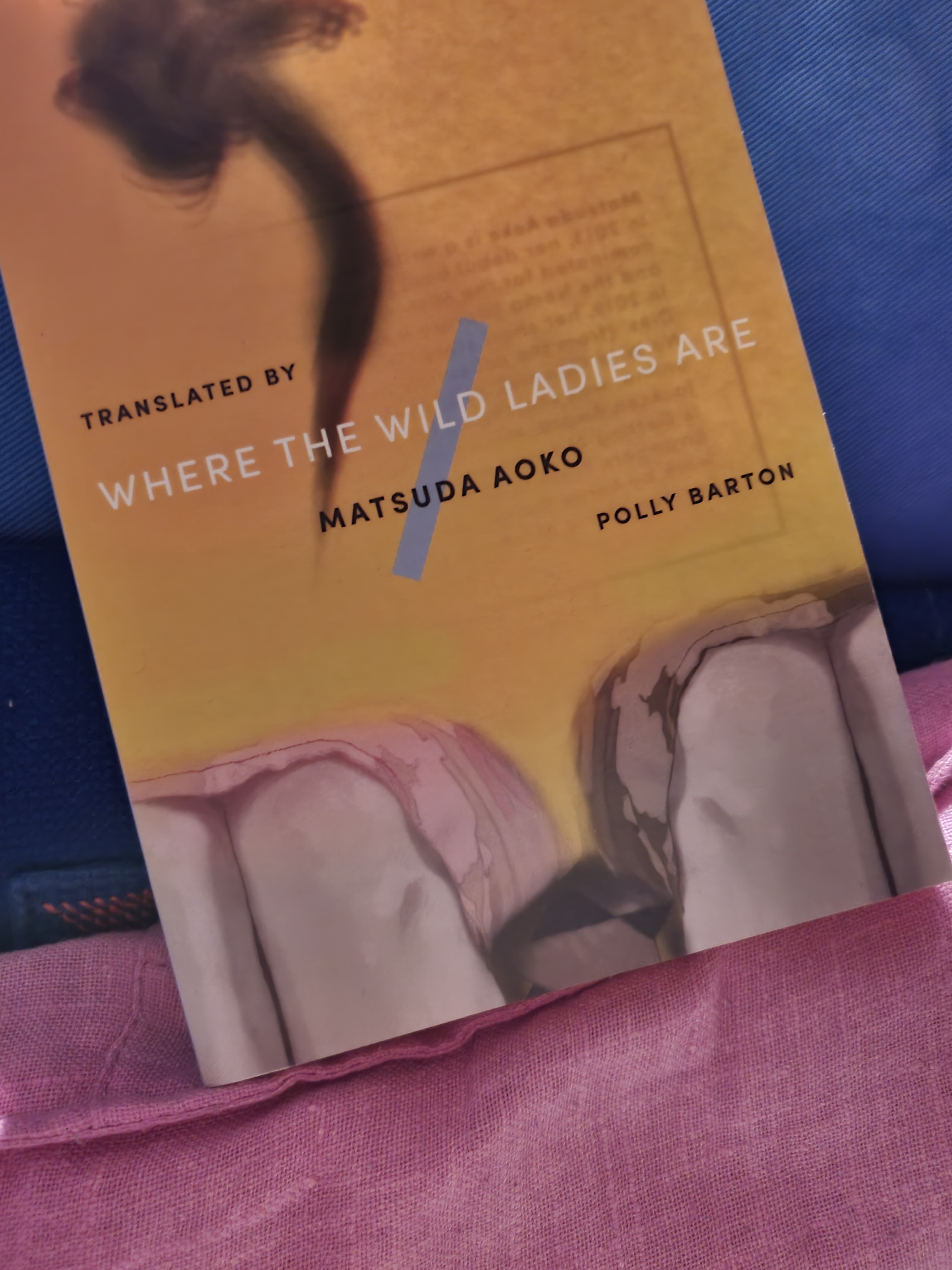
Where the wild ladies are, Aoko Matsuda / Polly Barton tr.
Owlish, Dorothy Tse / Natscha Bruce tr.
Queering Translation, Translating the Queer: Theory, Practic, Activism, edited by Brian James Baer and Klaus Kaindl, Routledge, 2018
Queer in Translation, edited by B. J. Epstein and Robert Gillett, Routledge, 2017
Ma, Yahia Zhengtang. “Queering the Translation of Same-Sex Desire: English Translations of 1990s Queer Literature of Taiwan as Examples.” TranscUlturAl, vol. 14, no. 1, 2022, pp. 37-53.

 小说 XIAOSHUO 小說
Leave a comment