
It was a lovely surprise to receive the latest issue of Prism (2024, 21:2) in my mailbox in the woods not least because it included our themed cluster on gender politics and Sinophone sci-fi: Three amazing essays by Huang Yingying, Cara Healey, and Mia Chen Ma as well as a lovely foreword by Mingwei Song who organised the cluster and my own oceanic analysis, which I had a lot of fun writing.
Here are some excerpts from my piece “Space Oceans: Posthuman Frontier Feminism in the Astro-nautical Hydrocommons”:
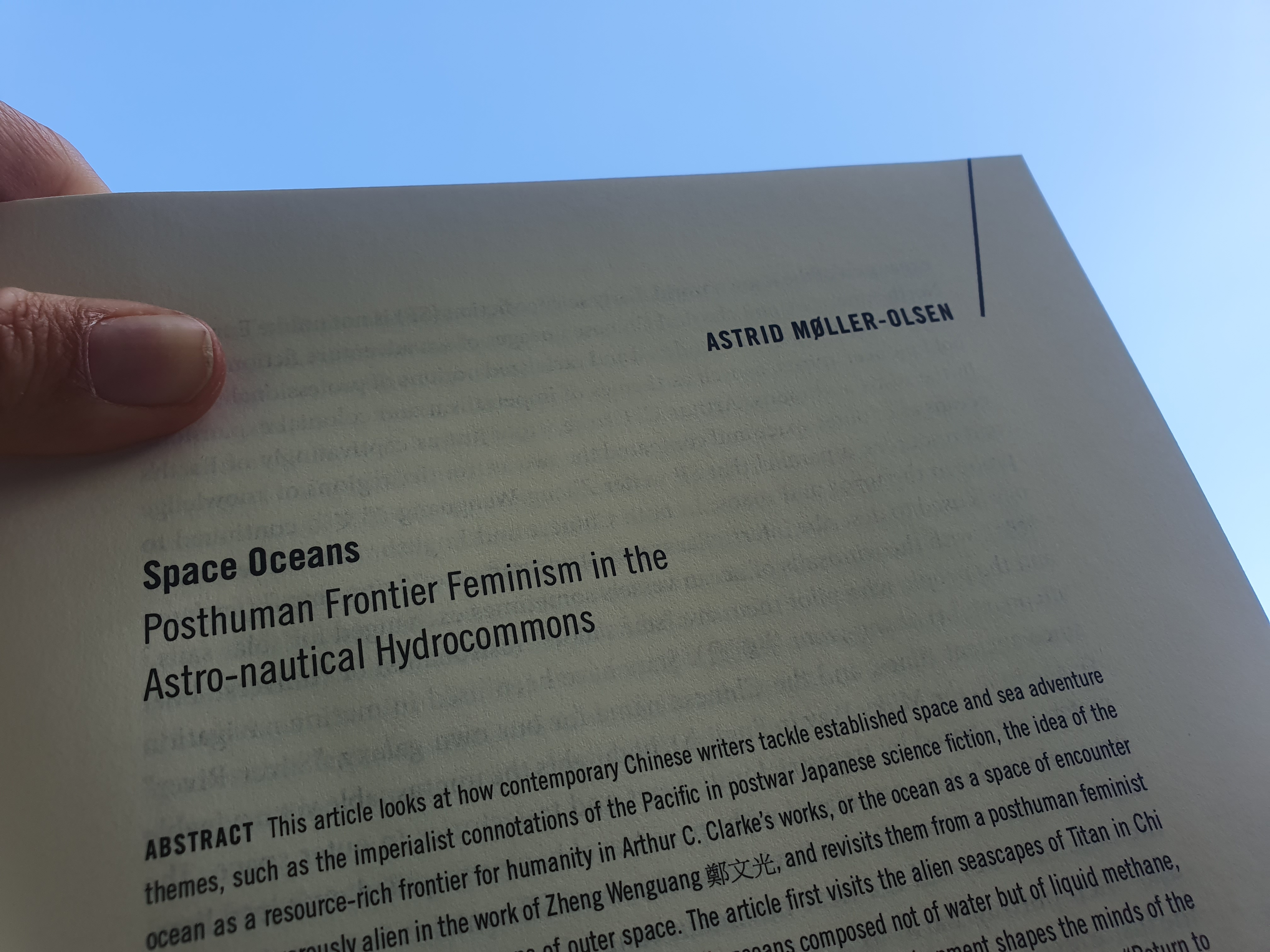
“This article looks at how contemporary Chinese writers tackle established space and sea adventure themes, such as the imperialist connotations of the Pacific in postwar Japanese science fiction, the idea of the ocean as a resource-rich frontier for humanity in Arthur C. Clarke’s works, or the ocean as a space of encounter with the dangerously alien in the work of Zheng Wenguang 鄭文光, and revisit them from a posthuman feminist perspective as they explore the oceans of outer space. The article first visits the alien seascapes of Titan in Chi
Hui’s 迟卉 “Deep Sea Fish” (Shenhai yu 深海鱼), with its oceans composed not of water but of liquid methane,
analyzing the colonialist logic behind terrascaping and examining how the environment shapes the minds of the
human residents even as they try to shape their environment. Second, Regina Kanyu Wang’s 王侃瑜 “Return to
Mi’an” (Chongfan mi’an 重返弥安) is read as a text that highlights the duality of space and ocean as realms for both frontline exploration and ultimate homecoming, while problematizing the very notion of the frontier
itself, relying as it does on violent ignorance and erasure of earlier inhabitants. The article ends with a look at how Hu Shaoyan 胡绍晏 imagines the universe itself as an intergalactic ocean characterized by what Astrida Neimanis has called “the hydrocommons of wet relations.”
“In these stories, the (metaphorical) sea with its ecological connotations is both the beginning and destination of human evolution: they remind us of our own watery beginning and the many other species we still share our planet, our universe, and our bodies with. They underline the murkiness and nonlinearity of evolution, the possibility of alternative, multiple evolutions on other planets, as well as the continuation of coevolution with, and interdependence on, other species. These narratives of contemporary Chinese SF take their readers on a journey from Earth’s ancient seas into space and on to new seas on other planets in a chronicle of messy, multispecies coevolution that is both a voyage into the unknown and a return to our shared oceanic origins.”
“As this timely cluster on She-SF shows, it is important and necessary to create awareness around women and nonbinary writers of Chinese SF, and it is equally important to highlight that these authors do not belong to a feminized subcategory of SF but, rather, write themselves right into the heart of the living, evolving tradition of Chinese SF at its best.”
 小说 XIAOSHUO 小說
Leave a comment